Pet Leash Safety
When I started my journey developing the Alpha Leash, I found out very quickly that the safety of retractable leashes is a very polarizing subject. Among dog owners, trainers and other dog professionals there is a very strong and vocal opinion that retractable leashes are not as safe as fixed leashes.
Because consumer and pet safety are the most important parts of the Alpha Leash’s design, I was very concerned with this opinion and its accuracy. So, I went looking for the truth.
Before I start my investigation, I want to be clear that I am not a veterinarian or a dog trainer. However, I am an engineer and have had many years of experience in problem solving complex systems and issues. With those experiences I have learned time and time again that data is where the truth lies. This is because data isn’t biased by pre-conceptions, emotions, personal experience or other biases. Data shows the facts in black and white and allows a conclusion to be made without bias.
To start with I defined the major injury categories relating to pet leashes;

1. CAUGHT IN LEASH CORD OR RIBBON
Injuries under this heading are caused when a leash gets tangled with a part of a person or a pets body causing lacerations, bruising and other related injuries.

2. Struck by Leash
Injuries caused by the retractable leash's end clip being propelled into someone by the retraction mechanism.

3. TRIPPED
Tripping over a dog leash.

4. TRIPPED OWN
The dog owner specifically tripping over their OWN leash.

5. PULLED DOWN BY OWN
Dog pulling down the dog walker.

6. OTHER
All other injuries relating to a pet leash but that do not fit into any of the categories above.
I then searched for pet leash injury data, and thanks to the United States Consumer Product Safety Commission, I found it (https://www.cpsc.gov/Research--Statistics/NEISS-Injury-Data).
Once downloaded the data was cleaned up from its raw form, filtered it to include just pet leash related injuries and the injury categories, listed above, were applied (a link to this data set can be found below).
One thing to note is that there was no categorization of the type of leash, fixed or retractable, that was involved in the injury.
And now the data;
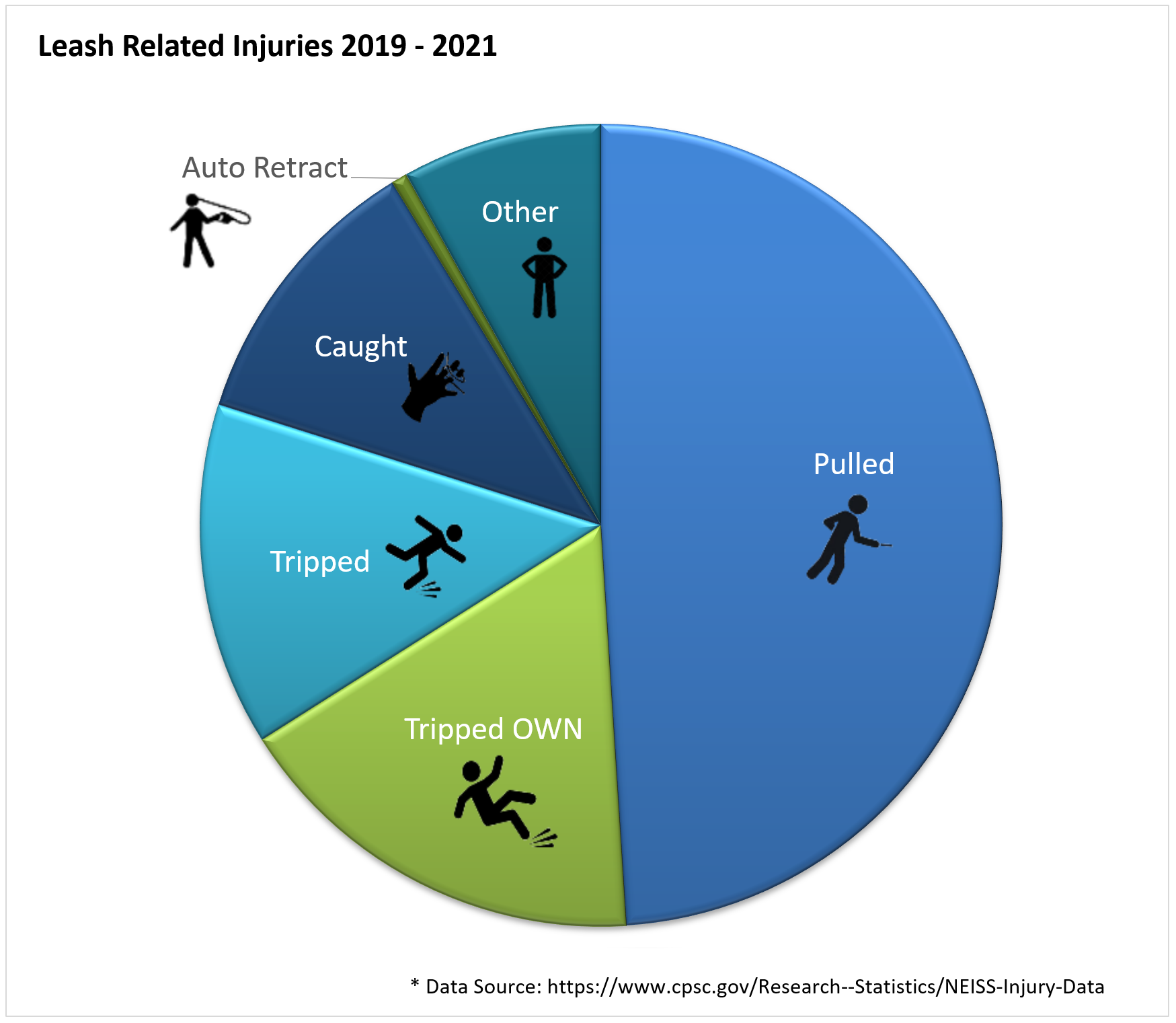
66% of pet leash injuries or 584 people each year go to hospital because they’ve been uncontrollably pulled by their pet or because they tripped on their own leash. A retractable leash prevents both of these injuries. First, the retraction mechanism allows a pet the freedom to move away from their owner, preventing surprise pulls. And second, it keeps the leash taught between the pet and its owner, so that the leash is not on the ground and will not be a tripping hazard.
As you can clearly see the data shows that retractable pet leashes can prevent more than half of leash related injuries, which means they are not the safety hazard that some have portrayed them to be.
However, even with that finding there is the more sobering fact that over 850 people per year, in the US, suffered a pet leash related injury. Taking your pet for a nice walk should not result in an injury.
That is why I believe the ultimate solution to eliminate leash injuries is a combination of both improved leash design and proper education and training on how to use a leash safely.
Thank you, and stay safe out there!
Edward